
Dispatch · cravings
How to Survive a Nicotine Craving in 90 Seconds: The Urge Surfing Method That Works in 2026
by Clean Break Team · · 17 min read

It is 11:47 p.m. You spent the last hour telling yourself tomorrow will be different. Then the craving lands like a brick through glass. Your chest tightens. Your hand reaches for the vape that is not there, the pack you threw out, the bottle you poured down the sink. Every cell in your body screams for relief. You have about ninety seconds before you either ride this wave or let it pull you under.
You can survive this. You can survive every single nicotine craving with nothing more than your attention and a method that works the moment the alarm goes off in your brain. The method is called urge surfing, and when you anchor it to the 90-second rule, you take the single most powerful weapon out of the addiction’s hands. Here is exactly how it works, why it works, and how you can use it tonight.
What Is Urge Surfing?
Urge surfing is a mindfulness technique that treats a craving not as a command you must obey but as a wave that rises, peaks, and falls on its own. You do not fight the wave. You do not white-knuckle through it. You simply observe it, ride it, and let it dissolve underneath you. The term comes from the work of psychologist Alan Marlatt, who developed relapse prevention strategies for addiction. He noticed that when people stopped trying to eliminate their cravings and instead learned to sit with them, the cravings lost their grip.
Think of a craving as a physiological event, not a moral failing. Your brain triggers a surge of dopamine anticipation because it learned that nicotine equals relief. That anticipation creates a physical sensation in your body: a hollow feeling in your stomach, heat in your neck, pressure behind your eyes. Urge surfing teaches you to zoom in on those sensations with curiosity instead of panic.
A craving is just a conditioned response. You do not have to act on it any more than you have to scratch every itch. And like an itch, when you stop fighting it and simply notice it, the sensation starts to change. This is the core of urge surfing.
The Science Behind the Wave
When you vape or smoke, nicotine floods your brain with dopamine within ten seconds. Your brain adapts by pruning dopamine receptors, leaving you in a constant state of chemical deficit. Between doses, dopamine levels drop below baseline. The craving you feel is your nervous system ringing an alarm bell, saying, “Fix this deficit now.”
That alarm triggers a cascade of stress hormones: cortisol, adrenaline. Your heart rate inches up. Your breathing gets shallow. Your attention narrows until the craving fills your entire field of awareness. This is the body’s ancient survival wiring, repurposed by a chemical dependency. The good news: this full-body stress response lasts only about ninety seconds if you do not feed it with additional thoughts. Neuroscientist Jill Bolte Taylor famously described this window in her research on emotional processing. An emotion, including a craving, takes roughly ninety seconds to flush through your body. Everything after that window comes from the story you tell yourself about the feeling.
That is where you regain control. You cannot stop the initial surge. You can absolutely refuse to chase it with the thoughts that turn ninety seconds into a relapse.
The 90-Second Rule: Why Cravings Feel Overwhelming But Are Fleeting
The 90-second rule changes how you experience a crave. Instead of bracing for a battle that might last an hour, you know you only have to hold steady for a minute and a half. This is not a motivational slogan. It is a neurological fact. When you understand what happens inside your brain during that window, you stop being a victim of the craving and start becoming its observer.
The Neurochemistry of a Nicotine Craving
Nicotine binds to acetylcholine receptors in your brain, releasing a flood of dopamine. In response, your brain downregulates those receptors. When you stop using nicotine, those receptors remain underactive, and your dopamine tone plummets. Any cue associated with vaping, a smell, a place, a time of day, a feeling of stress, triggers a conditioned dopamine dip. That dip creates a “wanting” signal that feels exactly like hunger or thirst, because your brain treats it as survival-level urgency.
The Cleveland Clinic explains that nicotine withdrawal symptoms like anxiety, irritability, and intense cravings peak in the first few days and can last for weeks, but each individual craving follows a much shorter curve.[^1] The craving spike is a burst of neural firing. That firing is metabolically expensive, and your neurons cannot sustain it for long. The wave breaks on its own.
How Your Thoughts Turn 90 Seconds Into an Hour
The initial wave lasts less than two minutes. What keeps you trapped is the internal dialogue that immediately follows: “I cannot do this.” “This is too hard.” “Just one hit would stop this feeling.” “I quit anyway, so one slip does not count.” Those thoughts trigger a second stress response, and then a third, and soon the wave feels never-ending.
That is the real battleground. The craving itself is just chemistry. The suffering comes from believing the thoughts that pile on top of it. Urge surfing works because it puts all your focus on the physical sensation, which will pass, and starves the mental loop of your attention.
When you pull out a timer, like the 90-second urge timer inside the Clean Break app, you turn an abstract panic into a concrete starting gun. You press the button. You watch the seconds count down. You know exactly how long you have to ride. That clarity alone can cut the craving’s power in half.
The Craving Cycle: How Nicotine Hooks Your Brain
Before you learn the steps, you need to see the full cycle that nicotine builds inside your mind. Every craving follows the same arc, and when you identify each stage, you can interrupt it before it reaches the point of no return.
| Stage | What Happens in Your Brain | Physical Sensation |
|---|---|---|
| Trigger | An external cue (sight of your vape, morning coffee) or internal state (stress, boredom) activates the craving circuit in the nucleus accumbens. | Subtle restlessness. A flicker of anticipation. |
| Anticipation | Dopamine dips, creating a feeling of lack. The prefrontal cortex starts rationalizing use. | Tightness in chest, shallow breathing, increased salivation. |
| Peak | The amygdala fires a distress signal. Cortisol surges. The craving feels urgent and unignorable. | Racing heart, tense muscles, a hollow ache in your gut. |
| Crash (if you give in) | Dopamine spikes briefly after use, reinforcing the loop. Guilt and self-criticism follow, which become new triggers. | Temporary relief, then deeper emptiness. |
| Wave Dissolution (if you surf) | Without action, the neural firing pattern exhausts itself. Dopamine stabilizes naturally. | Sensations soften, breathing deepens, a sense of clarity returns. |
The crucial insight: the peak stage lasts about ninety seconds. If you can ride through the peak without adding mental fuel, the craving collapses on its own. Smokefree.gov notes that vaping cravings typically crest quickly and that distracting yourself for even a few minutes can be enough to ride them out.[^2] The 90-second rule turns that observation into a precise, repeatable protocol.
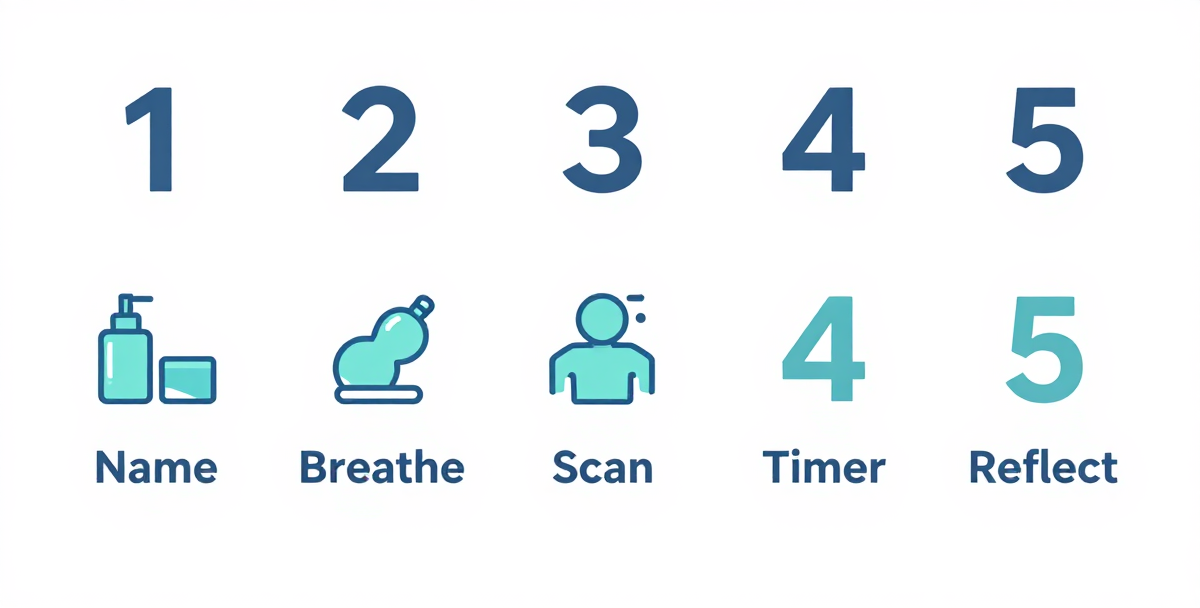
How to Urge Surf a Nicotine Craving in 5 Steps
This is the method you use the moment a craving hits, whether you are on day one or day 100. You need no special training. You need only your attention and the willingness to sit with physical discomfort for one and a half minutes.
Step 1: Name the Craving
As soon as you feel the first surge, say to yourself, out loud or silently, “This is a craving.” Labeling the experience activates your prefrontal cortex, the part of your brain that plans and observes, and pulls you out of the reactive amygdala loop. You immediately step from being inside the craving to looking at it.
Do not analyze it. Do not judge yourself for having it. Just name it: “Craving.” That single word creates a small wedge of space between you and the sensation. That space is where your power lives.
Step 2: Ground Yourself in Your Breath
Take one long, slow breath in through your nose for a count of four. Hold it for a count of four. Exhale through your mouth for a count of six. The extended exhale activates your parasympathetic nervous system, which calms the stress response. Do this even if your hands are shaking. Especially if your hands are shaking.
Place one hand on your stomach. Feel it rise and fall. Your breath is the only thing you control right now, and it is enough. You are not trying to relax. You are simply giving your body a different signal than the craving’s alarm.
Step 3: Scan Your Body With Curiosity
Now turn your attention to the physical sensations. Where exactly do you feel the craving? Is it a tight band around your chest? A hot pulse in your throat? A jittery current running down your arms? Describe the sensation to yourself in neutral language: “There is pressure behind my eyes. There is a hollow tug in my solar plexus.”
Do not wish the sensation away. Do not label it bad. Treat it like a researcher studying a phenomenon. The craving is not an emergency in your body. It is just a collection of physical signals that your brain is interpreting as danger. When you observe them with curiosity, you stop reinforcing the danger signal.
Step 4: Ride the Wave With a Timer
This is the step where you bring in the clock. Open your quit app and start a 90-second timer. If you use Clean Break, the urge timer sits right on the home screen for the exact moment you need it. You press it, and the seconds start counting down. You can hold your phone, feel it in your hand, and watch the number drop from 90 to 0.
While the timer runs, keep breathing. Keep scanning your body. Notice how the sensations shift. Maybe the tightness in your chest spreads and then retreats. Maybe the heat in your face flares and then cools. The craving is a wave, and waves are dynamic. They cannot stay still. The timer proves to you, in real time, that the intensity does not last.
If your mind wanders to “I need nicotine,” bring it back to the number on the screen and the feeling in your body. You only have to do this for ninety seconds. You can survive anything for ninety seconds.
Step 5: Reflect on the Wave That Passed
When the timer ends, take one more deep breath. Notice what changed. The craving may not be completely gone, but its sharp edge will have dulled. The screaming urgency will have quieted to a whisper. Acknowledge what you just did: you faced an intense neurological storm and did not light anything up, did not drink anything, did not pick up the pen. You stayed.
This moment of reflection is critical. Your brain learns from experience. Every time you ride out a craving without giving in, you weaken the neural pathway that connects the trigger to the behavior. You literally rewire your brain toward freedom.
To deepen your understanding of the sensations you feel during a crave, read our breakdown of the anatomy of a craving. Knowing what your brain is up to makes it far easier to ride the wave without panic.
The Nicotine Withdrawal Timeline: What to Expect Day 1 to 30
Urge surfing works on any individual craving, but you also need to know the broader landscape you will travel through. The frequency and intensity of cravings change as your brain heals. Understanding the timeline keeps you from being ambushed and helps you interpret each wave correctly.
The following timeline synthesizes clinical data from the Cleveland Clinic and the experiences of thousands of people who have quit vaping.[^1] Your experience may vary in detail, but the arc is universal.
| Timeframe | Physical Symptoms | Emotional & Mental State | Cravings Frequency |
|---|---|---|---|
| Day 1–3 | Peak withdrawal. Headaches, dizziness, tingling in hands and feet, increased appetite. | High anxiety, irritability, brain fog, sadness. Feels like an emotional hangover. | Intense and frequent. Cravings can hit every 15–30 minutes. This is the neurological emergency your brain signals when nicotine leaves your system. |
| Day 4–7 | Physical symptoms begin to ease. Coughing might increase as lungs clear. Sleep disruption continues. | Mood swings begin to stabilize. The emotional rawness of day three often peaks. You might hit a wall of doubt. | Cravings remain strong but spacing widens slightly. Triggers feel sharper because they are now psychological as much as physical. |
| Week 2 | Most acute physical symptoms fade. Lingering fatigue, occasional headaches, vivid dreams. | A sense of emptiness or flatness. You may feel bored or aimless because nicotine previously filled every pause. | Cravings morph from constant background noise to situational waves. You will feel them during habitual moments: after a meal, with coffee, when stressed. |
| Week 3–4 | Physical symptoms largely gone. Body has expelled all nicotine and its metabolites. | Mood baseline begins to lift. You start experiencing small moments of natural dopamine: a genuine laugh, satisfaction from food, calm during a sunset. | Cravings become intermittent and less intense. They can still surprise you, but they no longer occupy the center of your day. |
| Month 1 onward | No physical withdrawal. Brain receptor density gradually normalizes over weeks to months. | Emotional stability returns. You may still get nostalgic cravings linked to specific memories or extreme stress. | Rare but potentially intense. These “extinction bursts” happen less and less frequently as you continue to surf. |
The wall that hits around day three can be particularly disorienting. We cover exactly why that wall appears and how to push through it in our guide on the day three wall. Read it before you get there so you will recognize the pattern and know it does not mean you are failing.
Why Willpower Alone Fails and How the 90-Second Timer Changes the Game
Willpower models all share the same flaw: they ask you to resist a craving indefinitely, using sheer mental force. Research shows willpower depletes over the course of your day. Every time you resist a temptation, you draw from a finite reservoir. By 11 p.m., when the hard craving hits, your tank is empty.
The 90-second approach bypasses this entirely. You do not need to resist indefinitely. You need to hold steady for one countdown. That is not a test of character. That is a simple physical assignment. Anyone can do ninety seconds.
This is where a quit app built for the moment of craving becomes a tool, not a lecture. Clean Break’s design operates on the insight that information does not help you at 11:47 p.m. when your whole body is on fire. A timer does. A pinned reason on your screen does. The words you set for yourself, your reminder that you are quitting for your lungs, your daughter, your freedom, give your prefrontal cortex a foothold when the amygdala screams.
The app also shows you money saved in real time. That number ticking upward is the opposite of the craving. It is tangible gain accruing second by second while you ride the wave. It reconnects you to the outcome you actually want.
The NHS quitting resources stress that distractions, activity substitutes, and phone-based support significantly increase your odds of stopping vaping for good.[^3] Tools that put an immediate, concrete action between you and the use decision are more effective than advice alone. A 90-second urge timer is that action.
Tools That Make Urge Surfing Easier
Urge surfing requires only your attention, but a handful of tools can anchor you in the first weeks when your attention feels scattered. Use whatever keeps you from lighting up or hitting the pen. There is no award for doing this without help.
The Clean Break 90-Second Urge Timer
This is the core tool inside Clean Break. You open the app, you press the timer, and you watch the seconds tick from 90 to zero. During that countdown, the screen shows the reason you pinned when you started. You read it while you breathe. The timer turns an overwhelming internal event into an external, manageable task. You can get early access at cleanbreak.app.
A Breath That Works in Real Life
You do not need a meditation routine. You need one breath that works when your jaw is clenched. Try the “four count in, six count out” pattern described in Step 2. The long exhale is the key. It slows your heart rate via the vagus nerve. Practice it once when you are calm so your body knows the pathway. Then use it when the wave hits.
Your Reason, Written Down
Pinning your reason is not sentimental. It is neuroscience. When the craving centers are firing, your long-range planning circuits go offline. Having a written phrase, “I quit to run a 5K with my son,” or “I quit because I refuse to be owned by a USB stick,” gives your higher brain a handhold. The Clean Break app lets you pin that reason on the main screen so you do not have to generate motivation from scratch in the middle of a craving. The NHS also recommends keeping a physical list of reasons with you at all times.[^3]
Real-Time Savings Tracker
Nicotine is expensive. Watching a dollar amount climb in real time while you surf a crave turns the moment from a loss into a gain. You are not just not using; you are earning. That shift in framing matters on the bad nights. The Smokefree.gov tools emphasize tracking money saved as a powerful motivator.[^2] When you see a tangible reward accumulating second by second, the craving’s illusion that you are depriving yourself of something breaks apart.
Community and Distraction
Sometimes you cannot surf alone. Text a friend who knows you are quitting. Open a distraction game. Step outside into the cold air. The Truth Initiative suggests five concrete strategies, including physical activity and keeping your mouth busy with water or gum, to handle nicotine withdrawal.[^4] Combine a physical move with the timer: do ten pushups while the ninety seconds tick down. You will be amazed how the craving evaporates by rep eight.
For a full set of strategies, browse our guides section. We cover everything from managing vape-related anxiety to rebuilding your dopamine baseline.
Why This Works for Vaping, Smoking, Alcohol, and Weed
Urge surfing is not specific to nicotine. The wave-like nature of cravings applies to any substance or behavior that your brain has learned to use for reward or relief. Alcohol cravings, weed cravings, even compulsive scrolling, all follow the same arc: trigger, dopamine anticipation, physical surge, peak, and fall. The 90-second window holds.
MD Anderson Cancer Center addiction specialists emphasize that managing any substance withdrawal requires learning to sit with discomfort while the brain recalibrates its reward system.[^5] That recalibration does not happen through avoidance. It happens through direct exposure to the craving without the reward. Every wave you surf is a repetition that rewires your brain toward independence.
If you are quitting multiple substances, or if you are using vaping to quit smoking and now need to quit vaping itself, this method becomes even more critical. The withdrawal timeline shifts slightly depending on the substance, but the micro-method of surfing a single craving stays identical.
Watch Urge Surfing in Action
Sometimes seeing the technique modeled makes it click. This video, published in May 2026, walks through the urge surfing method step by step, showing how to handle cravings in recovery with nothing but your breath and your attention.
Master Urge Surfing: How to Handle Cravings in Recovery
Watch it now, before the next craving hits, so you recognize the posture and the breathing rhythm when you need them.
Common Pitfalls and How to Avoid Them
You will stumble. That is part of learning. Here are the most frequent ways people trip up while learning urge surfing, and how to correct them immediately.
You Try to Make the Craving Disappear
If you are watching the timer hoping the craving will vanish at exactly zero, you will likely feel disappointment when some residual sensation lingers. The goal is not elimination. It is survival without using. The craving may drop from a ten to a three and remain there for a while. That is a win. You did not use. The wave passed. Take the win. Over time, the post-wave intensity level will drop lower and lower.
You Hold Your Breath Instead of Breathing
When anxiety spikes, the natural tendency is to hold your breath or breathe shallowly. This maintains the stress response. Force the long exhale even if it feels unnatural. The physiological signal of a long exhale overrides the anxiety feedback loop.
You Engage With the Thought Stories
A thought like “Just one puff will take the edge off” may appear. If you argue with it, you give it oxygen. If you agree with it, you relapse. Instead, note it: “There is the just-one-puff thought.” Then return your attention to the physical sensation. The thought is not a command. It is a mental reflex. You do not argue with a hiccup; you wait for it to pass.
You Wait for Motivation to Show Up First
Motivation does not arrive before you act. It arrives after you take the first step. Do not sit around hoping to feel ready to surf. Start the timer the instant you notice the craving. Action creates the motivation you were waiting for.
You Let One Slip Become a Full Relapse
You may give in to a craving. It happens. The danger is not the single slip. The danger is the story that you have blown it entirely and might as well keep going. A slip is a single wave you did not ride. It says nothing about your identity or your future. Get back on the board immediately. The Clean Break app lets streaks survive one bad night because a lapse is data, not a verdict. You can learn more about this approach on our blog in posts about rebuilding after a lapse.
Key Takeaways
- A nicotine craving is a wave, not a command. It rises, peaks, and falls on its own if you do not fuel it with additional thoughts.
- The neurological surge of a craving lasts about 90 seconds. Everything beyond that comes from the mental story you attach to the sensation.
- Urge surfing involves five steps: Name the craving, ground your breath, scan your body with curiosity, ride the wave using a timer, and reflect on the wave that passed.
- You do not need willpower. You need a concrete external tool like a 90-second timer that turns an indefinite battle into a short, manageable task.
- Withdrawal follows a predictable timeline. The physical symptoms peak on days 1 to 3, ease by week two, and largely resolve by month one, while cravings shift from constant to situational.
- Tools amplify your effort. A pinned reason, a real-time savings tracker, and a breath technique give your prefrontal cortex strong anchors when the craving hits.
- A lapse is not a relapse. One wave you did not ride is information, not identity. You can start surfing again on the very next craving.
FAQ
What if my craving lasts longer than 90 seconds?
The initial peak of the craving, the acute emotional and physical surge, lasts about ninety seconds. You may still feel a dull echo or tension afterward because your brain continues to process the trigger. That does not mean the method failed. It means the wave has passed and you are now dealing with lower-level aftereffects. Keep breathing. Start the timer again if you need to. Often the residual sensation fades within a few more cycles. With practice, the after-wave period shortens.
Can I use urge surfing for other addictions?
Absolutely. Urge surfing works for any conditioned craving, including alcohol, cannabis, gambling, and binge eating. The neurobiological arc of a craving is universal. The substance or behavior changes the specific trigger, but the wave pattern remains identical. Many addiction specialists from MD Anderson and other institutions recommend mindfulness-based techniques across substance use disorders for this very reason.
How often do nicotine cravings happen?
Frequency depends on how long you used nicotine, your delivery method, and your individual neurochemistry. Early in a quit, in the first three days, you may feel cravings every twenty minutes. By week two, they often spread to once every hour or two, mostly tied to habitual cues. After a month, you might get a random intense craving once a day or a few times a week, and those gradually become rarer. Each craving you surf weakens the neural pathway that generates the next one.
Does urge surfing really work for heavy vapers?
Yes. Heavy vapers who use high-concentration nicotine salts often face sharp, physically intense cravings. Urge surfing is not a gentle technique for mild urges. It directly addresses the brute force of a strong craving by breaking it into its physical components. The higher the craving intensity, the more dramatic the effect of the 90-second timer because you get concrete proof that even the worst wave subsides. Truth Initiative research supports mindfulness and distraction as effective tools for vapers who struggle with intense urges.[^4]
What if I give in to a craving? Can I still recover?
Yes. A single slip does not erase your progress. The worst thing you can do after giving in is to conclude that you have failed and throw away your quit. Instead, treat the slip as data. Ask yourself what triggered the slip and what you can do differently next time. Start the timer again on the very next craving. Your brain keeps the healing it has already done. Read more about how to handle a lapse without turning it into a full relapse in our guides section and on the Clean Break blog. You are always one wave away from being right back on track.
[^1]: Cleveland Clinic. “Nicotine Withdrawal.” https://my.clevelandclinic.org/health/diseases/21587-nicotine-withdrawal [^2]: Smokefree.gov. “Dealing with Vape Cravings.” https://smokefree.gov/quit-vaping-resources/dealing-with-vape-cravings [^3]: NHS. “How to Quit Vaping.” https://www.nhs.uk/better-health/quit-smoking/ready-to-quit-smoking/vaping-to-quit-smoking/how-to-quit-vaping/ [^4]: Truth Initiative. “Quitting Vaping: Here Are 5 Tips for Handling Nicotine Withdrawal.” https://truthinitiative.org/research-resources/quitting-smoking-vaping/quitting-vaping-here-are-5-tips-handling-nicotine [^5]: MD Anderson Cancer Center. “Addiction specialist: How to manage nicotine withdrawal.” https://www.mdanderson.org/cancerwise/addiction-specialist-how-to-manage-nicotine-withdrawal.h00-159776445.html
Before the next wave
Clean Break launches soon.
The SOS that outlasts the craving, the streak that grows into a planet, your body's repairs mapped hour by hour. One email at launch, that's the whole newsletter.